
Sri Lanka, often called the Pearl of the Indian Ocean, is a land with a history spanning over 2,500 years. This beautiful island nation has witnessed the rise of ancient kingdoms, the spread of Buddhism, foreign invasions, colonial rule, independence, and modern transformation. Its story is one of resilience, culture, heritage, and national identity.
Early Settlements and Ancient Beginnings
Archaeological evidence shows that humans lived in Sri Lanka thousands of years ago. The earliest known inhabitants were prehistoric communities, including the Balangoda Man, believed to have lived around 34,000 years ago.
Historical tradition states that around 543 BC, Prince Vijaya and his followers arrived from northern India and established one of the earliest recorded kingdoms. This event is often considered the beginning of Sri Lanka’s documented history.
The indigenous people of Sri Lanka, known as the Vedda community, also have a deep-rooted heritage that continues today.
The Arrival of Buddhism
One of the most significant turning points in Sri Lankan history came in the 3rd century BC during the reign of King Devanampiya Tissa.
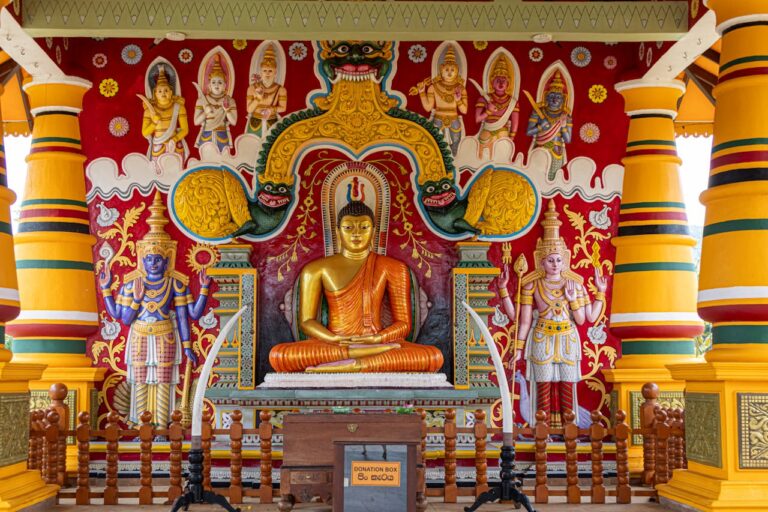
Buddhism was introduced to Sri Lanka by Arahat Mahinda, the son of Indian Emperor Ashoka. This transformed Sri Lankan society, influencing religion, education, architecture, law, and daily life.
Important Buddhist landmarks such as:
- Mihintale
- Anuradhapura
- Sri Maha Bodhi
- Ruwanwelisaya
became central to the island’s spiritual and cultural identity.
The Great Ancient Kingdoms
Anuradhapura Kingdom (377 BC – 1017 AD)
The Anuradhapura Kingdom was Sri Lanka’s first major civilization.
Achievements included:
- advanced irrigation systems
- giant reservoirs (tanks)
- magnificent stupas
- organized governance
- agriculture-based economy
Remarkable constructions:
- Jetavanaramaya
- Abhayagiri
- Thuparamaya
- Sri Maha Bodhi
This period marked one of Asia’s greatest ancient civilizations.
Polonnaruwa Kingdom (1070 – 1232 AD)
After invasions from South India, power shifted to Polonnaruwa.
The most famous ruler was King Parakramabahu I, who transformed the kingdom with:
- Parakrama Samudraya reservoir
- improved agriculture
- military strength
- trade development
The famous Gal Vihara statues were created during this era.
Medieval Kingdoms
Political power later moved through several capitals:
- Dambadeniya
- Yapahuwa
- Kurunegala
- Gampola
- Kotte
These kingdoms focused on preserving Buddhism and defending the island.
The Kingdom of Kandy
The Kandyan Kingdom became the final independent Sinhala kingdom.
It successfully resisted many foreign invasions.
Important legacy:
- Temple of the Sacred Tooth Relic
- preservation of traditional arts
- Kandyan dance culture
- royal customs
Kandy became the symbol of Sri Lankan independence and identity.
Colonial Era
Sri Lanka’s strategic location attracted European colonial powers.
Portuguese Rule (1505–1658)
The Portuguese arrived in 1505.
They:
- controlled coastal areas
- spread Christianity
- built forts
- interfered in local politics
Dutch Rule (1658–1796)
The Dutch defeated the Portuguese.
Their influence included:
- legal reforms
- trade expansion
- canal construction
- colonial architecture
Galle Fort remains a famous Dutch landmark.
British Rule (1796–1948)
The British eventually controlled the whole island.
Major changes:
- railway construction
- road networks
- plantation economy
- tea industry development
- English education system
Sri Lanka became globally known for tea production.
However, colonial rule also brought economic inequality and political control.
Independence
Sri Lanka gained independence from Britain on February 4, 1948.
It was first known as Ceylon.
In 1972, the country officially became the Republic of Sri Lanka.
Modern Political History
Social and Political Changes
Post-independence Sri Lanka saw:
- democratic governance
- educational expansion
- infrastructure development
- industrial growth
Civil Conflict
One of the most difficult chapters was the civil conflict from 1983 to 2009.
This conflict caused major human suffering, economic damage, and national division.
Its end in 2009 marked a major turning point toward rebuilding.
Sri Lanka Today
Modern Sri Lanka is known for:
Culture
A rich blend of Sinhala, Tamil, Muslim, Burgher, and indigenous traditions.
Tourism
Popular destinations include:
- Sigiriya
- Ella
- Mirissa
- Galle
- Kandy
- Nuwara Eliya
- Yala
Economy
Key sectors:
- tourism
- tea exports
- garments
- agriculture
- technology
Heritage
Sri Lanka has several UNESCO World Heritage Sites.
Why Sri Lanka Is Unique
Sri Lanka stands out because of its:
✔ ancient civilization
✔ Buddhist heritage
✔ cultural diversity
✔ colonial history
✔ natural beauty
✔ resilience through change
Conclusion
Sri Lanka’s story is not just a history of kings and kingdoms—it is the story of a nation shaped by spirituality, struggle, culture, and hope.
From ancient reservoirs and sacred temples to modern cities and global connections, Sri Lanka continues to inspire the world as a nation rich in heritage and promise.