
Udarata (Kandyan) Painting Traditions


Udarata (literally “upcountry” or Hill Country) art refers to the Kandyan-period painting tradition centered in Sri Lanka’s central highlands (the Kandyan Kingdom, 1469–1815). These are predominantly temple murals and devotional paintings in the Sri Dalada Maligawa (Temple of the Tooth) and other hill-country shrines. The style fully matured in the mid-18th century under Buddhist revivalist kings like Kirti Sri Rajasinha. Udarata paintings are characteristically narrative and schematic: scenes from the Buddha’s life or Jātaka tales are laid out in horizontal bands on red backgrounds, with strong black outlines, flat areas of white/yellow/green, and stylized floral or animal motifs. The art served a didactic, devotional function – educating common devotees in Buddhist stories – and symbolized Kandyan cultural identity. After the British annexation (1815), Western techniques (perspective, portraiture) entered Sri Lankan art, but Udarata murals remain a celebrated heritage. This post overviews their history, key styles and motifs, techniques and materials, notable artists (past & present), and cultural themes; it also lists free image/video sources (Wikimedia, Pexels, Unsplash, etc.), download/embed instructions, SEO-friendly structure, an FAQ, a media-source comparison table, and a mermaid timeline of major historical periods.
Historical Overview (Origins & Periods)
Kandyan painting began taking shape under the later Kandyan kings (1469–1815), though surviving murals date largely from the 18th century. After Portuguese incursions in the 1600s and the Buddhist ordination revival (upasampadā) of 1753, King Kirti Sri Rajasinha (r.1747–1782) sponsored many new temples and murals. The Kandyan school of painting “fully emerged and matured” in the mid-18th century. Major works include the Madawala vihāra murals (~1755–60) and Degaldoruwa Temple (~1770–80), by which time the style had a “well-defined identity”. Artists organized royal workshops (e.g. Devargampola Silwaththena’s studio at Ridi Vihāra) to decorate shrines with continuous narrative friezes. After 1815 and colonial rule, Kandyan art declined, but it has since been conserved in temples and museums.
1469Kandyan kingdomfounded (cap.Kandy)1747Kirti Sri Rajasinhabegins reign(Buddhistrevival)【13†L114-L122】1755-1760Madawala Templemurals (Kandyanstylematures)【13†L124-L130】1770-1780Degaldoruwa Templemurals completed(Kandyan style fullydefined)【13†L126-L130】1815Kandyan kingdomconquered (startBritish era, new artinfluences)【24†L152-L156】Kandyan (Udarata) Painting TimelineShow code

Styles, Motifs & Techniques
Udarata painting is characterized by strong outlines, flat planes of color, and rhythmic compositions. Figures are drawn in profile or hieratic poses, with elongated lines and minimal shading. The palette relies heavily on red backgrounds with bright white, yellow, green, and black pigments for figures and decorations. Murals are arranged in horizontal bands (“string of pearls” layouts) covering shrine walls; each band depicts one episode of a story, read in sequence (zigzagging right-to-left in one row, then left-to-right). To separate scenes, painters often include lotuses or stylized trees and rivers.
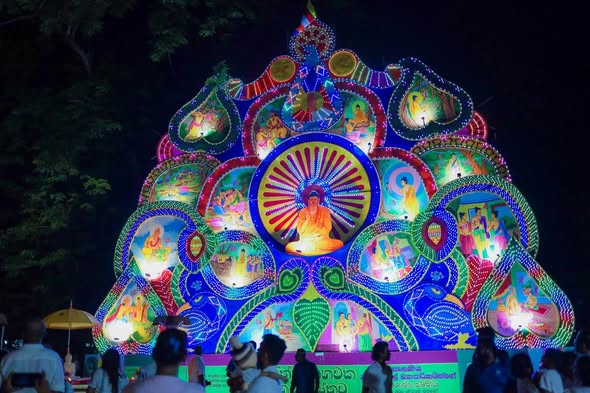
Buddha statue in a hill-country temple, with a colorful Kandyan-style mural behind. Udarata painting uses bold outlines and flat fields of color (e.g. red background, white/yellow garments) and stylized motifs.
Common motifs are Buddhist and folk narratives. Most murals depict the Buddha’s life events, Jātaka tales (previous lives), the first sermon (Dhammacakkappavattana), and local historical episodes. Mythical deities, guardian figures and temple festivals (e.g. the Perahēra procession) also appear. Purely decorative elements are abundant: flowers, vines, paisley and animal figures (lions, elephants, peacocks) fill borders and ceilings, reflecting Kandyan taste for ornamentation. This highly abstracted, non-perspectival style serves narrative clarity rather than realism.
Carved and painted brackets above the Temple of the Tooth inner sanctum (Kandy). These ornate Kandyan murals include lotus scrolls, mythical animals and royal motifs – typical of Makulu Meti (white-plastered) walls.
Techniques and materials are traditional: artists plastered walls with a white clay (Makulu Meti) before painting. Then using natural pigments (derived from minerals, plants and shells) they painted with brushes of animal hair. As noted in Kandyan fresco manuals, the backgrounds were often crimson-red, and colors like white (from lime), yellow (saffron), green (lead-tin oxide), black and grey (charcoal/ash) were mixed and applied carefully. Shades were built by overlaying these flat tones – any gradation was minimal. In practice, small skills sufficed: local lore recalls artists using rice-paste etc. for preliminary layouts and finishing delicate line-work in ink-like black. The result is a bold, graphic tableau on temple walls.
Notable Artists (Historical and Contemporary)
Unlike Western art, Kandyan artists rarely signed their work; most painters were monks or craftsmen of the Hiththara (Naēde) artist caste. We do know a few names from temple records and tradition:
- Rev. Devargampola Silvaththena (also Dewaragampola) – A monk who led the Ridi Vihāra (Silver Cave Temple) workshop. He painted the Ridi Vihāra murals and later Degaldoruwa (Matale) friezes around 1770. His style influenced many pupils.
- Dingiran Appu (Ahangama) – A celebrated secular painter of the late Kandyan era. He worked in the Southwest (Matara) but is sometimes linked to Kandyan motifs.
- Deldeniye Siththara Nāyade (Sittaranaide) – Artist of Suriyagoda, active in the late 18th c. Credited with temple murals in the Uva Province.
- Bodhinarayana Chithracharige Kapuru Nāyade and Wijayapala “Nētha” Nāyade – A family of painters (sons and nephews of earlier monks) who adorned temples in the late Kandyan period.
- Devendra Mulachari (Naēderi) – The last Kandyan palace architect (late 18th c.) who also painted some shrine images. He is famed for the Paththirippuva pavilion and Kandy Lake, but also practiced mural art under King Sri Wickrama Rajasinha.
With colonial and modern changes, fewer artists are known for pure Kandyan-style work today. However, some contemporary Sri Lankan painters (both in Kandy and the diaspora) incorporate Udarata motifs or techniques into ritual paintings, private shrines, and heritage projects. In recent decades, cultural preservation initiatives have revived temple painting commissions, training new artists in the traditional designs.
Cultural Significance & Themes
Kandyan paintings are deeply religious and cultural. They turn temples into visual guides for Buddhism. As one scholar notes, Kandyan murals were “meant exclusively for religious instruction”, helping unlettered devotees absorb Buddhist teachings. Scenes like the Parinibbāna (Buddha’s passing), Vessantara Jātaka (generosity tale) and the Pancha Sujāta (five maidens offering alms) are frequent. Local legends and royal pageantry (the Esala Perahēra festival) are also depicted, linking spiritual narrative with Kandyan identity.
Moreover, Udarata painting symbolizes Sri Lankan resilience and identity. During periods of foreign threat (17–18th c.), these murals affirmed Sinhala-Buddhist heritage. The color golden yellow often used on robes and halos signified enlightenment; red backgrounds suggested power and sanctity. Lotus flowers, bodhi leaves, and the Sinhalese lion motif (seen in Temple of the Tooth carvings) connect Kandyan art to island symbolism. In sum, themes of piety, kingship and nature abound. Throughout hill-country temples, murals played roles in temple festivals (processional banners, dancer backdrops) and monastic festivals, ensuring the paintings were not just decorative but woven into communal life.
Detail of a Kandyan-period fresco (Budugehinna Vihāra). Note the flat washes of color and bold black outlines on a red ground. The highly stylized figures and decorative lotus motif on the floor are typical of Kandyan narrative murals.